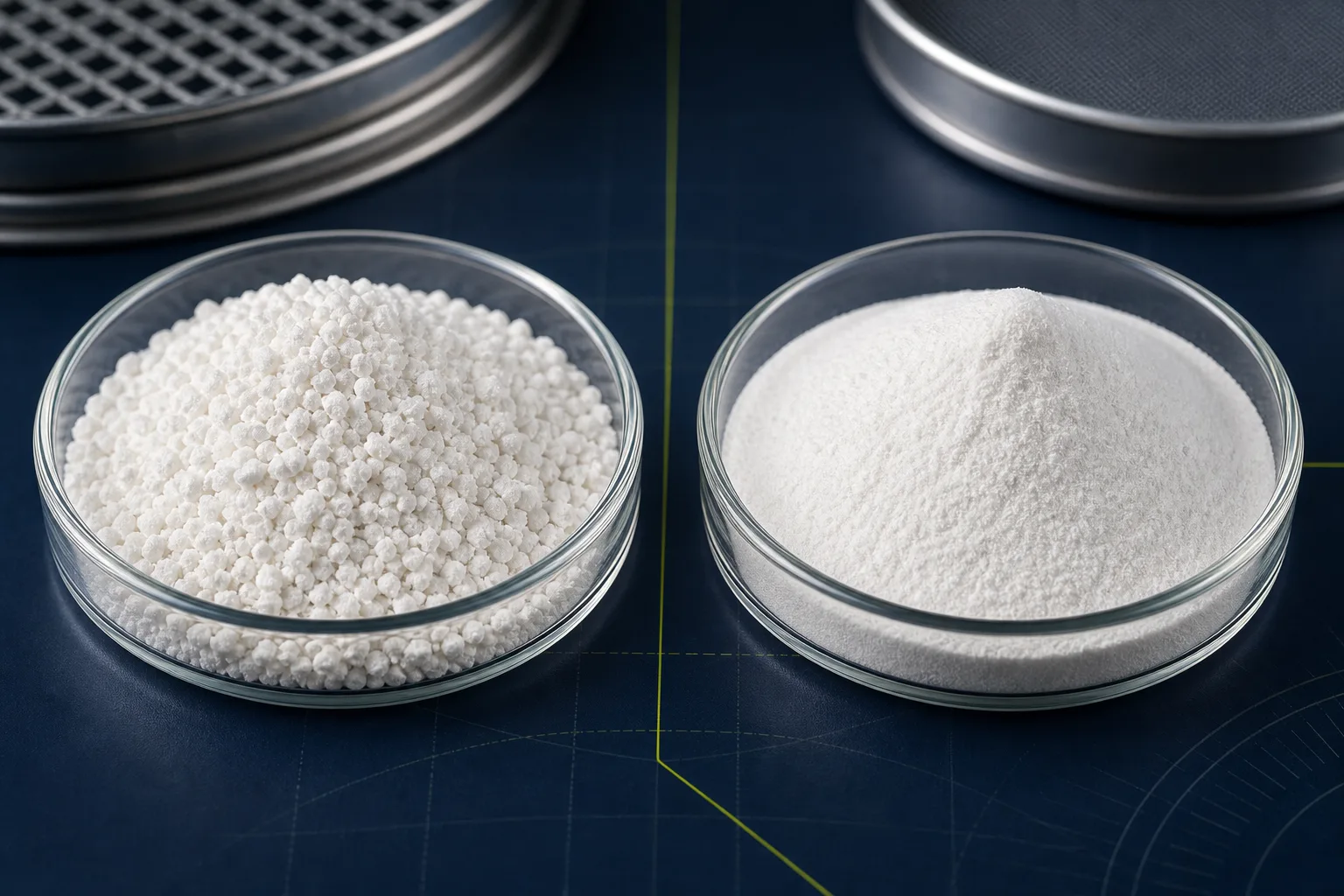
What mesh does—and does not—tell you
A mesh designation relates to the number of openings per linear inch in a sieve system, but the exact interpretation depends on the standard and the way the result is specified. A statement such as ‘passes 200 mesh’ is not identical to a full particle-size distribution.
Mesh does not tell you assay, identity, microbiology or elemental content. A finer powder is not automatically chemically purer. It is a physical specification that should sit beside the rest of the quality requirements.
| Decision area | 80 mesh direction | 200 mesh direction |
|---|---|---|
| Relative texture | Coarser | Finer |
| Handling | May offer different flow and dust behavior | May create more dust or cohesion depending on system |
| Dispersion goal | May suit applications without a very fine sensory target | Often evaluated where finer dispersion is desired |
| Compression or filling | Confirm on actual equipment | Confirm on actual equipment |
Match particle size to the product format
For finished powders, buyers often consider mouthfeel, suspension, blending uniformity and the behavior of the complete formula—not the creatine ingredient alone. Flavors, acids, sweeteners and other active ingredients can change the system.
For capsules and tablets, flow, bulk density, compressibility and tooling performance matter. A finer ingredient may behave differently during transfer and compression. For gummy or candy development, the ingredient enters a more complex formulation where dose, texture and process compatibility must be tested in the actual matrix.
- Powder tub or pouch sensory target
- Stick-pack filling behavior
- Capsule or tablet equipment
- Blend uniformity and dust control
- Prototype performance in chewable systems
How to write the particle-size requirement
Ask the supplier to state the offered grade, sieve or analytical method and acceptance criterion. If your process needs a distribution rather than a simple pass result, define the required reporting format before qualification.
Sampling remains important. A small evaluation lot allows technical teams to test blending, filling, dispersion or sensory behavior before commercial production. Keep the approved sample, specification and commercial batch linked through clear grade names and lot records.
Specifications, availability, documentation, prices and regulatory suitability must be confirmed for the exact product, manufacturing route and destination. This article is educational B2B information, not a product guarantee or legal advice.
Questions to resolve before purchase.
Is 200 mesh creatine always better than 80 mesh?+
No. It is finer, but suitability depends on the application, process and handling target. Purity and particle size must be evaluated separately.
Does finer creatine dissolve instantly?+
Finer particles can influence dispersion behavior, but temperature, mixing, formula composition and concentration also matter. Test the complete use case.
Should buyers request a sample of both grades?+
When particle size may affect processing or sensory performance, comparing samples under the intended conditions can support a more defensible choice.