Why MOQ changes from one quote to another
A standard stocked ingredient in factory packaging can have a different minimum from a custom particle-size requirement, private label fill or market-specific document program. Packaging components and production changeovers can also create their own minimums.
Instead of asking only ‘what is your MOQ?’, state the first-order target and annual forecast. The supplier can then distinguish what is technically possible from what is commercially efficient.
| Order stage | Primary purpose | Questions to settle |
|---|---|---|
| Sample | Technical screening | Grade, lot, documents, test plan |
| Trial order | Process or market validation | Packaging, freight, repeatability |
| Commercial order | Normal production supply | Lead time, release, delivery term |
| Program supply | Repeated replenishment | Forecast, cadence, safety stock, change control |
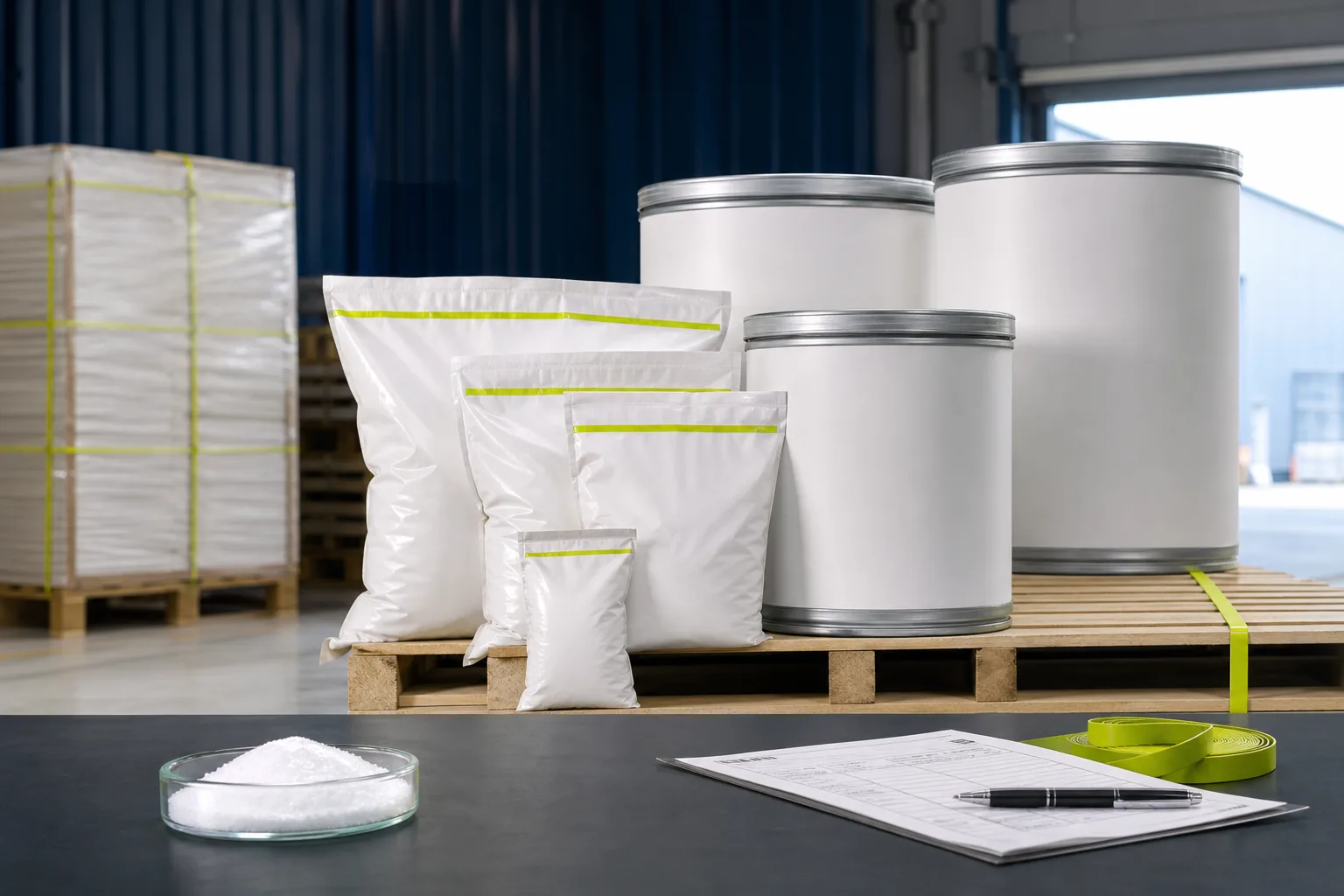
Understand the packaging hierarchy
A representative bulk format is 25 kg, but the exact inner liner, outer container, closure, pallet configuration and labeling should be stated in the quote. Packaging protects the ingredient, supports traceability and determines how efficiently material moves through the buyer’s receiving and production system.
Confirm net weight, units per pallet, pallet treatment when applicable, label information, lot identification and any destination-specific packaging requirements. Do not assume the same configuration across suppliers or grades.
- Inner food-contact liner
- Outer drum, carton or bag
- Seal and tamper evidence
- Lot and product identification
- Pallet and stretch-wrap configuration
- Storage and handling information
Calculate landed cost, not only ingredient price
The useful comparison includes ingredient value, packaging, testing or documents, origin charges, international freight, insurance where applicable, customs-related costs and delivery to the receiving location. Incoterm and shipment size change which costs are included in the supplier’s number.
Small shipments can be valuable for risk reduction but expensive per kilogram. Larger shipments may improve freight efficiency while increasing inventory and working-capital exposure. Model the order against consumption rate, shelf life, storage and launch uncertainty.
Specifications, availability, documentation, prices and regulatory suitability must be confirmed for the exact product, manufacturing route and destination. This article is educational B2B information, not a product guarantee or legal advice.
Questions to resolve before purchase.
Is 25 kg always the minimum order?+
No. It is a representative bulk packaging size, not a universal MOQ. Confirm the minimum for the exact grade, packaging and destination.
Why does a trial order cost more per kilogram?+
Smaller quantities can carry less efficient freight, handling, testing and order-processing economics. They may still be useful for reducing technical or market risk.
What should a bulk creatine RFQ include?+
Include grade, particle size, quantity, annual forecast, packaging, required documents, destination and preferred Incoterm or delivery point.